
Introduction: Equity Crowdfunding vs Startup Investment Apps (TL;DR + At‑a‑glance)
TL;DR
Founders: Equity crowdfunding shines when you want broad retail reach and brand momentum; startup investment apps fit if you prefer a curated GP/syndicate and can handle accreditation or tighter checks.
Investors: Equity crowdfunding is the “invest in startups app” for retail-sized checks and community energy; startup investment apps suit larger, often accredited checks with deeper sponsor diligence.
Key differences: Access (retail vs accredited), diligence depth (portal screen vs GP-led), fees (success vs carry), liquidity (rare vs none), control (crowd vs lead investor).
Zemyth in one line: a DeFi-native third path that adds milestone escrow, NFT liquidity, and yield - designed as the best way to invest in startups with on-chain transparency.
Why this comparison matters now
Traditional VC and bank credit are tighter, while retail tools - equity portals and the modern startup investment app - offer new, open access routes.
Momentum is real and growing:
"Global crowdfunding is projected to reach ~$16.61B in 2025 and grow at ~11.6% CAGR through 2034." - Source
Comparison at a glance
Feature | Equity Crowdfunding Portals | Startup Investment Apps | Zemyth (DeFi-native third path) |
|---|---|---|---|
Access (accredited vs retail) | Retail + accredited (jurisdiction-dependent; broad access) | Often accredited-first; some retail via feeder structures | Global wallet-based access; retail-friendly with safeguards and on-chain rules |
Typical Raise/Check Sizes | Raises up to ~$5M (Reg CF); $100–$5K typical checks | Syndicates/funds: $1K–$25K+ checks; raises vary widely | Milestone-tranched raises; flexible tiers; micro to large checks via NFT lots |
Founder Fees | ~5–8% success fee + legal/compliance | 0–3% placement fees (varies) + legal | 8% success + 1% per milestone unlock; fixed mint fee per investor NFT |
Investor Fees/Carry | Usually no carry; small processing fees | Typical 10–20% carry + 1–2% management | No carry; protocol fees with ZEM-based discounts up to 75% |
Diligence Depth | Light-to-moderate portal screening | GP/lead-led deep diligence | On-chain milestone proofs, investor voting, moderator gate |
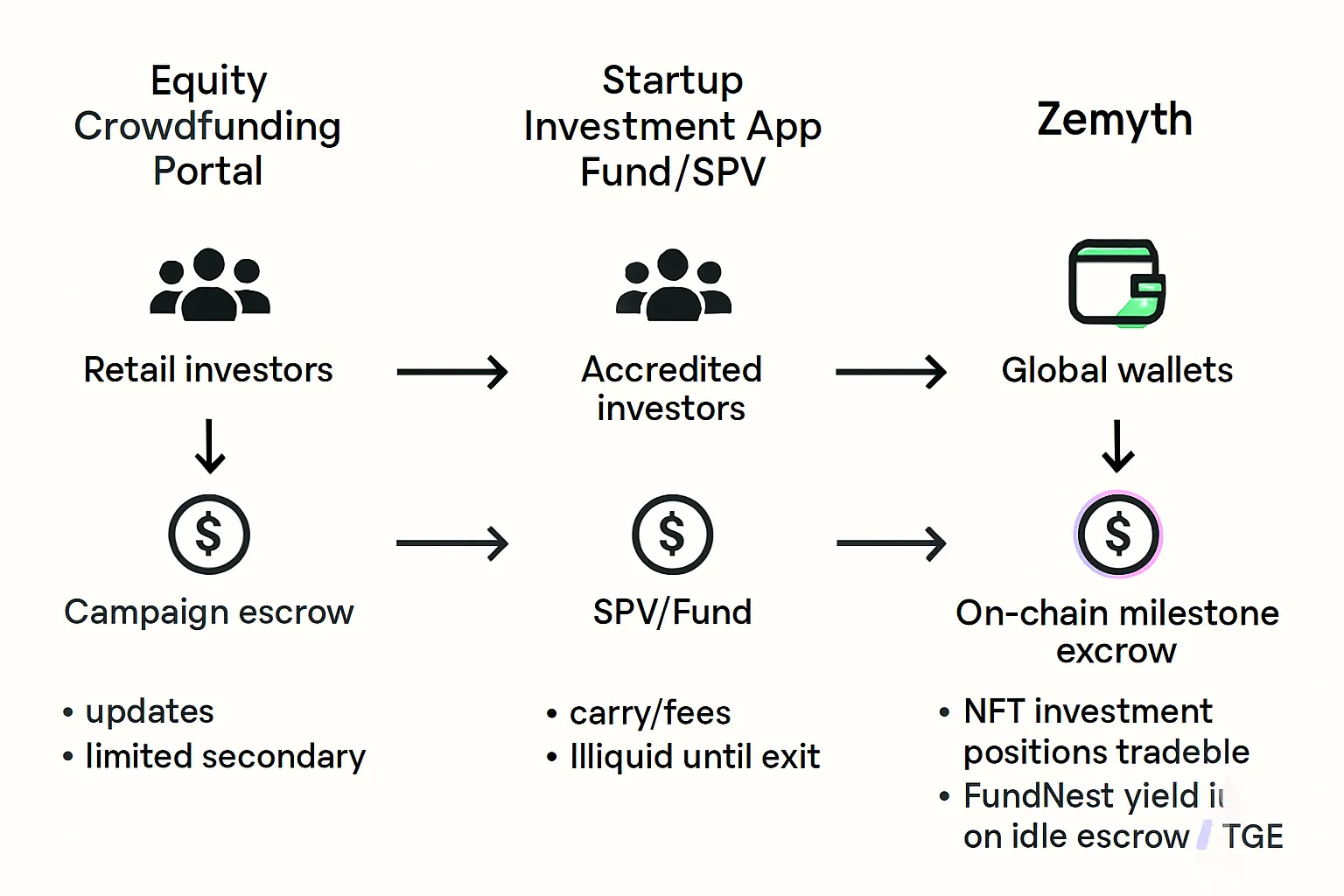
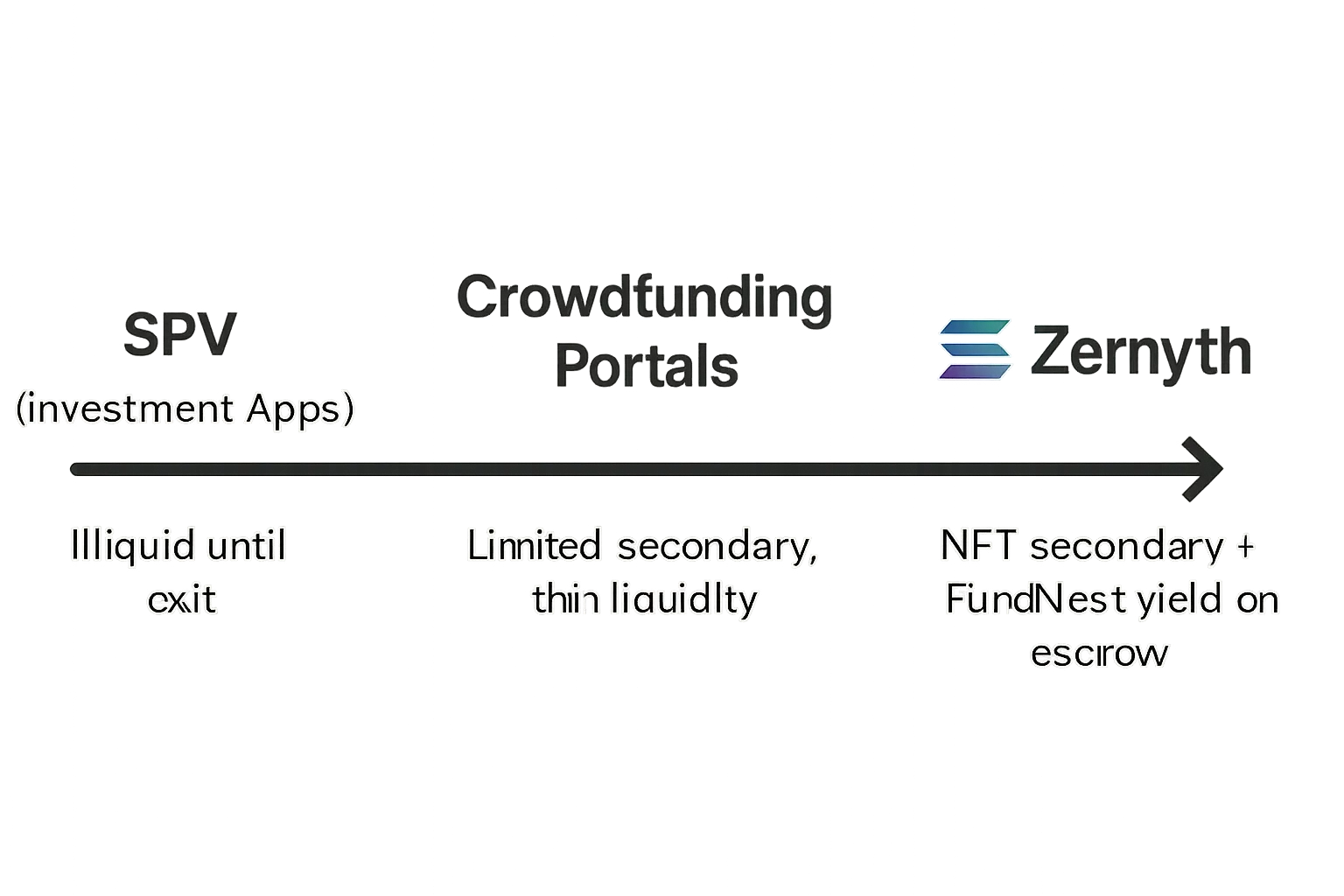
Liquidity/Secondary | Limited, occasional secondary | Generally illiquid until exit | NFT positions tradable; escrowed funds earn yield via FundNest |
Regulatory Path | Reg CF/Reg A+ (and regional equivalents) | Reg D syndicates/funds or app-specific structures | On-chain contracts + project-level compliance; tokenized rights |
Time-to-Launch | 4–12 weeks (prep, filings, page build) | 2–8 weeks (syndication, docs) | Days once milestones are defined; 7-day auto-approve fallback |
What you’ll learn
Clear definitions and who each path fits.
Eligibility and access (retail vs accredited), fees and carry, diligence depth, liquidity options, and risk.
How to choose the best place to invest in startups for your goals - and when Zemyth’s milestone+NFT approach is the smarter “app to invest in startups.”
Ready to explore a DeFi-native alternative to equity portals and syndicate apps? Start here: https://zemyth.app
What we’re comparing: Models and mechanics, clearly defined
Equity Crowdfunding Portals (e.g., Wefunder, StartEngine)
How it works: Founders launch Reg CF/Reg A campaigns with a public page, set minimum/maximum goals, and route incoming commitments to escrow. If the minimum is hit by deadline, the round closes and funds transfer; if not, capital is returned.
Typical investor experience: Quick KYC/AML, low minimums (often $100–$500), card/ACH payments, progress updates via the portal, and limited secondary options. Retail access is the norm, with standardized disclosures.
Founder experience: Weeks of prep (financials, Form C/A filings, narrative, video), compliance and escrow setup, heavy marketing to activate community, and closing mechanics (disbursement, cap table roll-up, ongoing investor updates).
Startup Investment Apps (e.g., AngelList, Sweater)
Access types: SPVs and syndicates (deal-by-deal), rolling funds (subscription-style commitments), and consumer-facing evergreen VC structures that pool checks and deploy across a pipeline of startups.
Typical investor experience: Eligibility varies (often accredited for SPVs/funds), higher minimums ($1K–$25K+), GP-led diligence and memos, periodic reporting, carry and management fees, and long hold times until an exit.
Founder experience: Capital arrives via a lead SPV or fund rather than hundreds of individuals; fewer line items on the cap table, negotiation with a lead, and distribution of rights through the sponsoring vehicle.
Zemyth (the bridge, high level)
Core mechanics: Milestone-gated escrow on Solana, Investment NFTs encoding rights (voting, token claims, transferability), yield on idle escrow via FundNest, and a contributor marketplace (CollabNest) that converts work into tokenized equity.
Incentive shift: Funds unlock only when milestones pass by community vote; investors can trade NFT positions for earlier liquidity; escrow earns yield instead of sitting idle; founders gain aligned capital plus a talent flywheel to accelerate delivery.
Eligibility, access, and minimums
Equity Crowdfunding Portals
Retail access by design: Both non‑accredited and accredited investors can participate, with platform- and jurisdiction-specific limits for individual investment amounts.
Typical check sizes: Commonly $50–$500+ per backer, with higher tiers available; some campaigns set minimums at $100–$250. Geographic availability depends on regulatory coverage and the portal’s supported countries.
Time-to-open and KYC: Account creation in minutes; KYC/AML typically completes within minutes to 1–2 business days depending on identity verification and payment method.
Startup Investment Apps
AngelList (SPVs and Rolling Funds): Primarily for accredited investors; access via deal-by-deal SPVs or subscription-based rolling funds with GP-led diligence and standardized docs.
Sweater (registered fund vehicle): Designed to enable non‑accredited investors to participate through a consumer VC structure with accessible minimums set by the fund; pooled capital is deployed across a portfolio rather than single deals.
App UX, setup, and KYC: Modern mobile/web onboarding with identity checks; accredited users verify income/net worth or provide third‑party verification. Typical minimums range from low three figures to low four figures depending on vehicle.
Founders: who can raise here?
Reg CF eligibility basics: Generally U.S.-based issuers (with some exceptions), annual raise caps under Reg CF, and a disclosure package (financials, risk factors, Form C/A) hosted on a registered intermediary. Campaigns set a minimum/maximum target and route funds to escrow until close.
Via apps (funds/SPVs) vs direct crowd: In app-driven models, founders raise indirectly - capital comes from a fund or SPV as one cap-table line item. In portals, founders raise directly from the crowd, trading broader retail reach for more hands-on marketing and disclosure requirements.
Fees and economics: what you’ll actually pay (and keep)
For Founders
Equity Crowdfunding Portals: Expect a platform success fee (commonly
5–8% of funds raised) plus payment processing fees (2–3% depending on card/ACH mix). Add campaign production and paid marketing (creative, video, PR, performance ads) and you can see a 8–15% drag on gross proceeds. The tradeoff: broad retail reach and powerful brand lift when executed well.Investment Apps/Funds: There’s no platform success fee paid by the company. Instead, the “cost” is classic equity dilution at the negotiated valuation, plus standard investor rights (pro rata, information rights, board observer, etc.). While you avoid portal fees, you’ll invest time in diligence, negotiation, and closing mechanics with the lead (or SPV/fund admin).
Net-proceeds reality check: With a portal, budget for both fees and marketing to avoid undercapitalizing your plan post-close. With funds/SPVs, price your round and terms right to preserve runway while keeping room for follow-ons.
For Investors
Crowdfunding: Most portals charge small transaction/processing fees at checkout; there’s typically no carry. You get retail-sized access and standardized disclosures, but diligence is lighter and you shoulder the work of filtering deals. Consider this the accessible “invest in startups app” style path for small checks.
Investment Apps: SPVs and funds usually include 1–2% annual management fees and 10–20% carry (plus possible SPV admin costs). In return, you gain curated deal flow, a lead’s diligence, and structured reporting. For larger checks, this can be the best way to invest in startups if you value sponsor quality and deal access.
Total-cost perspective: A zero-carry experience with limited support vs. a carry-bearing vehicle with GP-led curation. Choose based on your appetite for DIY diligence and the size/frequency of your checks.
Hidden costs to plan for
Legal/disclosure prep: Portals require formal filings and financials; funds/SPVs involve company counsel, investor rights docs, and closing coordination.
Campaign marketing: Creative, paid ads, PR, community management, and content - often the difference between “funded” and “stalled.”
Investor relations overhead: Updates, Q&A, and ongoing communication with a wider retail base (portals) or periodic reporting cadence with leads/LPs (apps).
Opportunity cost and timeline risk: Weeks to months of prep and execution can delay product milestones; missed timing windows can reduce momentum or force a downsize.
Diligence depth and signal quality
Equity Crowdfunding Portals
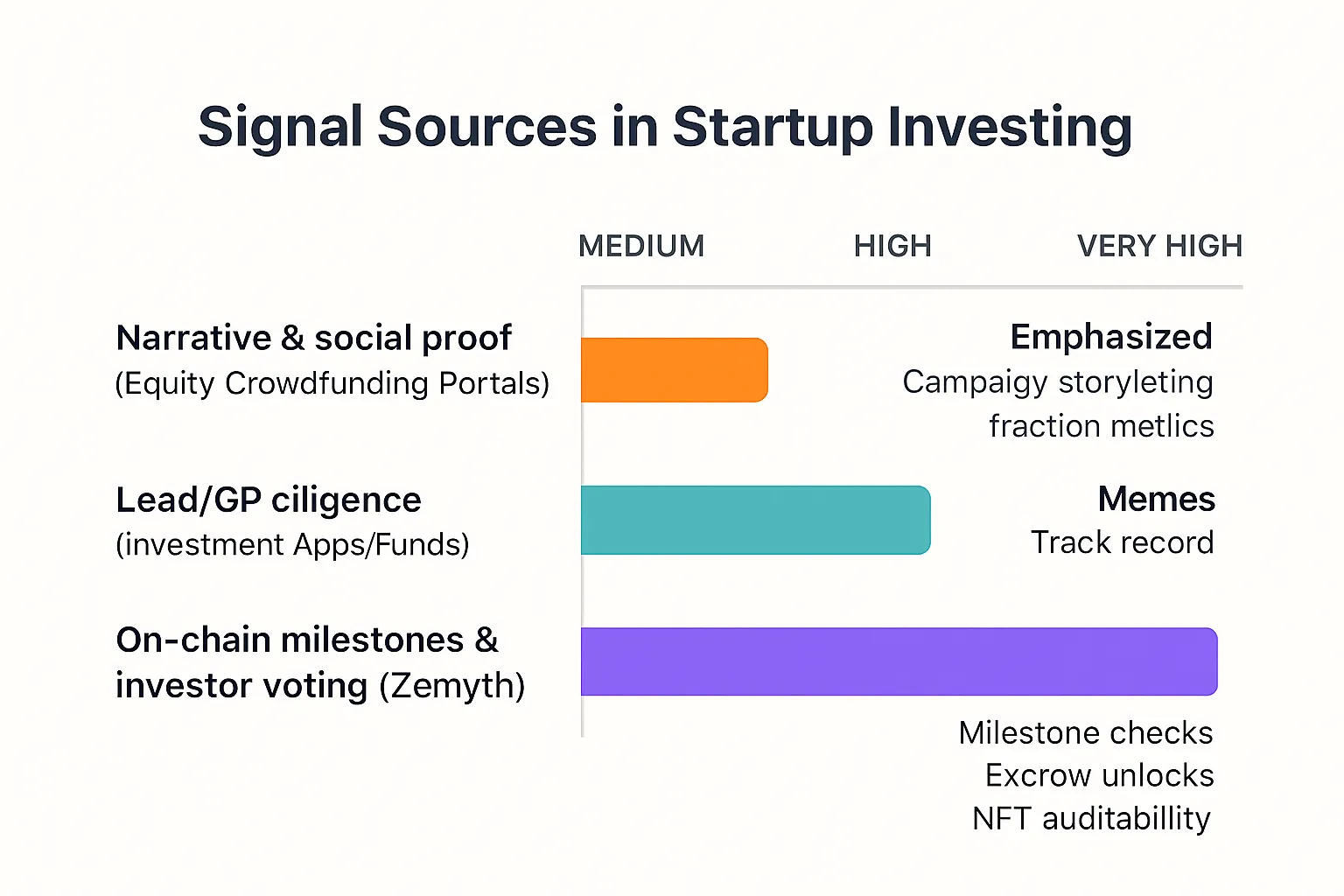
Light to moderate platform reviews; the burden of deeper diligence sits with individual investors.
Social proof, visible traction, and campaign storytelling carry significant weight in decision-making.
Startup Investment Apps
Leads/GPs screen and underwrite deals; curated pipelines and GP track records provide stronger pre-filtering.
Information rights and updates vary: SPVs often give deal-level reporting; funds provide portfolio-level letters and periodic deep dives.
How Zemyth raises the bar
On-chain, verifiable milestone proofs with investor voting and challenge windows create hard evidence, not just narrative.
Graduated protections (exits after repeated failures, shutdown votes, inactivity triggers) and transparent unlock logic align founder execution with investor safety and clarity.
Liquidity and exits: how (and when) you can get out
Equity Crowdfunding Portals
Liquidity: Generally illiquid. A few portals operate secondary marketplaces, but volumes are thin, trading windows are limited, and transfer constraints apply.
Realistic exits: M&A, IPO, or negotiated secondary blocks - timelines are uncertain and typically measured in years.
Startup Investment Apps
SPVs: Fully illiquid until the underlying company exits (acquisition, IPO, or secondary).
Funds: Long horizons with capital tied up across a portfolio; redemption windows, if any, tend to be restrictive and at manager discretion.
Zemyth’s approach to liquidity
Transferable NFT positions: Investment rights are encoded in NFTs that can be traded peer-to-peer, enabling earlier optionality versus waiting solely for a terminal exit.
Yield while you wait: Idle escrow can earn yield via FundNest’s curated pools, reducing cash drag between milestones and before TGE/token distribution.
Risk, regulation, and compliance (plain English)
Equity Crowdfunding Portals
High risk: Early-stage investing can result in total loss. Diversify and size positions accordingly.
Reg CF basics: Companies can raise up to an annual cap with standardized disclosures and must use SEC‑registered intermediaries; non‑accredited investors face investment limits. Not legal or tax advice - always consult a professional.
"Reg CF lets eligible companies raise up to $5M in 12 months; offerings must run through SEC‑registered intermediaries and include mandated disclosures and investor limits." - Source
Startup Investment Apps
Reg D (SPVs/rolling funds): Private placements for accredited investors; issuers and sponsors rely on exemptions with specific filing and solicitation rules.
Registered/qualified fund structures: Consumer-friendly vehicles operate under stricter oversight, delivering standardized reporting, audit requirements, and limits tailored to retail protections.
Practical takeaways
Match vehicle to risk tolerance and timeline: SPVs/funds can lock capital for years; portals democratize access but don’t remove risk.
Keep clean records: Expect K‑1s for partnerships/SPVs and 1099s for certain payouts. Track basis, follow-on rounds, and any secondary transfers for tax time.
Best‑fit scenarios for founders and investors
If you’re a founder
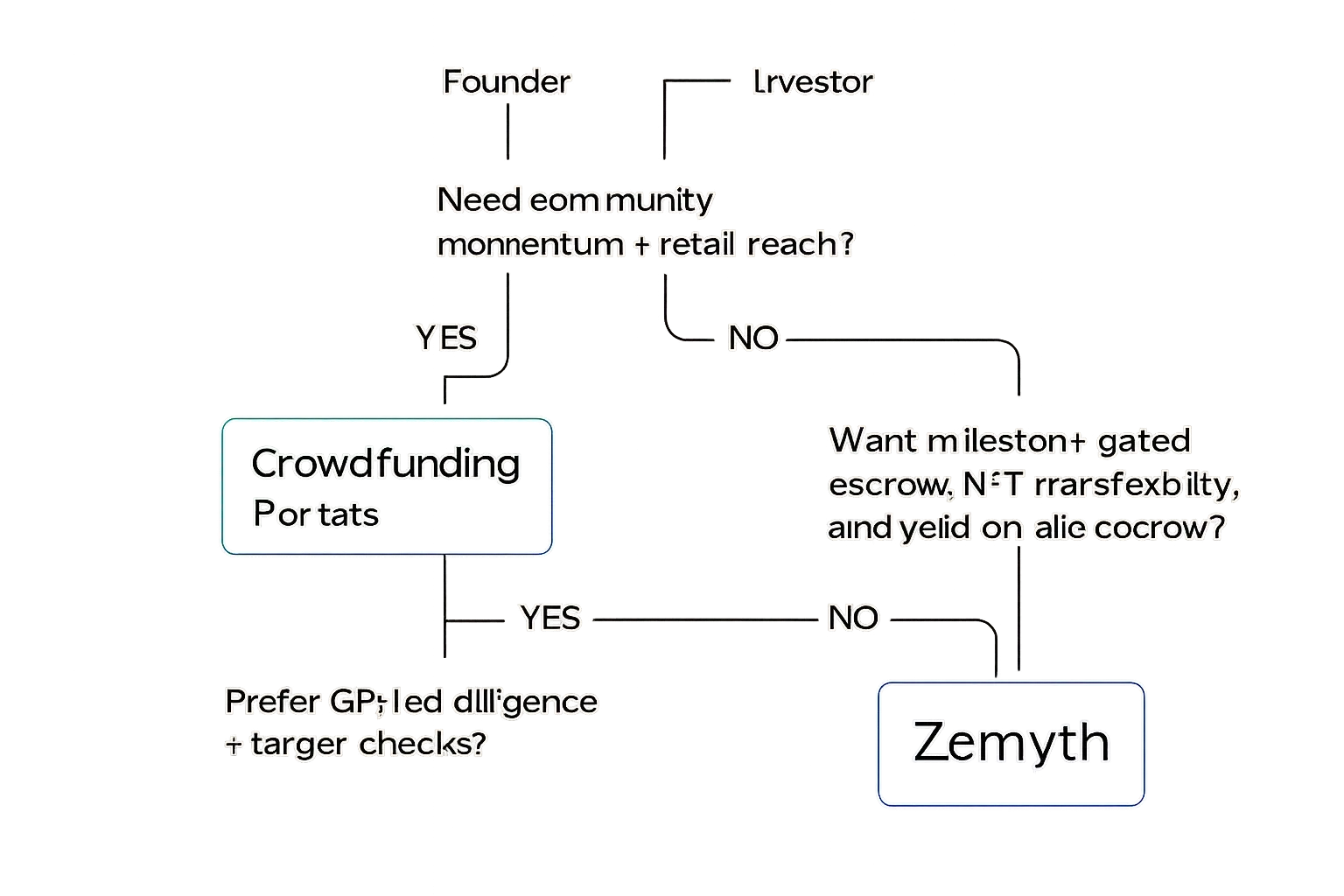
Choose Crowdfunding when you need community momentum, a preorder-style marketing flywheel, and broad retail buy‑in to validate demand.
Choose Investment Apps/Funds when you want concentrated checks, a lead’s support on diligence and terms, and credible follow‑on potential.
Choose Zemyth when you want milestone‑gated releases, transparent investor voting, and NFT-based liquidity options for early supporters - plus yield on idle escrow via FundNest.
If you’re an investor
Crowdfunding portals: Best for small checks, brand affinity, and building a learning portfolio with broad exposure.
Investment apps: Best for curated access and sponsor diligence - accepting carry/fees in exchange for fewer line items and structured reporting.
Zemyth: Best for on-chain milestone proofs, transferable NFT positions for optionality, and escrow yield that reduces cash drag while you wait.
A third option: how Zemyth blends access, accountability, and yield
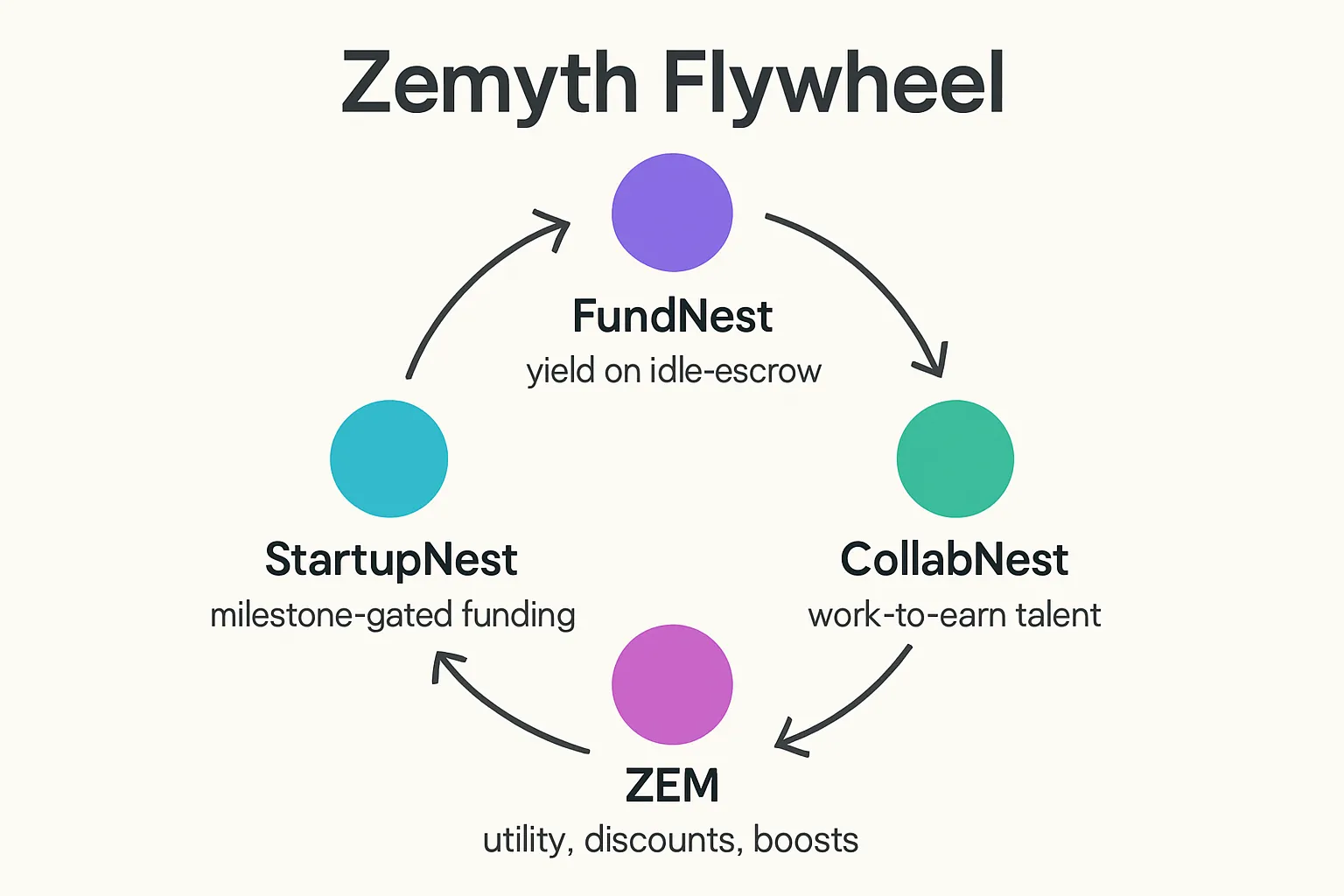
Milestone‑gated funding (StartupNest)
Escrowed tranches release only when milestones pass investor votes.
48‑hour unlock challenge windows and pivot exit windows create real-time accountability.
Moderator gate + on‑chain timelines reduce ambiguity and protect against inactivity.
Liquidity and rewards
Investment NFTs encode voting, token-claim, refund/withdrawal, and transfer rights, enabling secondary trading.
At TGE, holders claim project tokens; a portion remains escrowed for 30 days post‑TGE as added protection.
Idle escrow can earn yield via FundNest’s curated pools, reducing cash drag while milestones progress.
Community execution flywheel
CollabNest activates work‑to‑earn: contributors complete bounties for tokenized equity (cNFTs), accelerating milestone delivery.
ZEM utility aligns incentives: fee discounts, FundNest yield boosts, vote‑to‑earn, and priority access - with emissions capped by platform revenue.
When Zemyth is a strong fit
You want on‑chain transparency, milestone accountability, and optional liquidity while you wait - without sacrificing community ownership.
Final verdict: Which path fits your goals?
Quick recommendations
Founders: community-first product or brand → Equity Crowdfunding; enterprise/lead-driven scaling → Investment Apps/Funds; transparency + milestone control + optional liquidity → Zemyth.
Investors: learn-by-doing with small checks → Crowdfunding; curated exposure with leads → Apps/Funds; milestone-proofed exposure + potential yield → Zemyth.
Pros/cons matrix
Path | Crowdfunding Portals | Investment Apps/Funds | Zemyth |
|---|---|---|---|
Pros | - Retail access; low minimums for backers - Marketing flywheel and brand lift for founders - Simple “invest in startups app” experience for small checks | - GP-led screening and memos - Concentrated checks and cleaner cap tables - Potential access to hotter deals via syndicates/funds | - Milestone‑gated escrow and investor voting - NFT positions enable optional secondary liquidity - FundNest yield reduces cash drag while waiting - On‑chain transparency and clear unlock logic |
Cons | - Lighter diligence; investors self‑filter - Success/processing fees reduce founder net - Secondary markets are thin/limited | - Carry and management/admin fees - Accredited eligibility common; higher minimums - Illiquid until exit (SPVs) or long fund horizons | - New model to learn (NFTs, wallets) - Still venture risk; milestones can fail - On‑chain processes require basic crypto fluency |
CTA
Explore deals, milestones, and yield on Zemyth: https://zemyth.app